When Guidance Becomes Control: Autonomy & Motivation in Dance
Dance is rarely just about steps. It is shaped by relationships, environments, and the unspoken rules we absorb along the way. Teachers, studios, and training cultures influence not only how dancers move, but how they think, feel, and relate to themselves.
Dance spaces are powerful. They can nurture confidence, autonomy, and curiosity — or quietly reinforce fear, self-doubt, and compliance. In this blog, we explore autonomy, intrinsic motivation, and the role of communication in dance education, with a focus on creating environments that support both high performance and long-term wellbeing.
Why does this matter?
When dancers spend significant time in the studio, teachers naturally become mentors and authority figures. This creates a unique power dynamic within dance education. Students often look to their teachers for approval, permission, and validation when making decisions — both big and small. Over time, a dancer’s choices can become shaped not only by their own goals, but by a desire to meet expectations, gain praise, or avoid disappointment.
This is where the line can begin to blur. While dance teachers hold significant influence, we do not own our students’ decisions. Yes, a student’s choices may reflect aspects of their training, but what matters far more is how we respond. Do we communicate clearly enough for students to make informed decisions? Do we engage in discussion and support their autonomy? Or do we shut down choices that don’t align with our own preferences?
Influence becomes problematic when it turns into control — especially when students feel unable to question, explore, or decide for themselves. This raises an important question: why does this line feel particularly blurred in dance?
Why does this line feel particularly blurred in dance?
Paige, NDC STEP Up Program 2025
The line between influence and control often feels more blurred in dance than in many other educational settings due to a unique combination of power, proximity, and identity development.
Dance training is typically hierarchical. Teachers hold significant authority over casting, corrections, progression, performance opportunities, and access to external pathways. Research in educational psychology shows that when authority figures control valued outcomes, students are more likely to prioritise compliance over autonomy — even when this compliance conflicts with their own needs or goals (Deci & Ryan, 2000; Reeve, 2012).
Dance is also a high-contact, high-immersion environment. Students often train with the same teachers for many years, multiple times per week, during critical periods of identity formation. During adolescence in particular, individuals are especially sensitive to approval, rejection, and belonging (Steinberg & Morris, 2001). In these conditions, teacher influence can become deeply internalised — not just as guidance, but as a measure of self-worth.
Additionally, dance places the body itself at the centre of evaluation. Corrections are constant, public, and visible. Research suggests that environments with frequent evaluation and comparison increase self-monitoring and reduce autonomy, especially when expectations are implicit rather than clearly communicated (Guay, 2022; Barber, 1996).
Finally, many dance cultures continue to reward traits such as sacrifice, obedience, endurance, and silence — qualities that can look like dedication but may discourage questioning or self-advocacy. When these traits are praised without equal emphasis on communication and choice, students may learn that safety and approval depend on compliance that aligns with these traits.
Together, these factors create an environment where influence can quietly shift into control, not necessarily through overt pressure, but through unspoken rules, conditional approval, and fear of consequences. This is rarely intentional — but it is impactful.
Autonomy
Autonomy is a core psychological need (Guay, 2022; Nakhla, 2025). When this need is unsupported, individuals are more likely to experience anxiety, depression, disengagement, and a reduced quality of life. The concept comes from Self-Determination Theory (SDT), which proposes that humans have an inherent drive toward growth, mastery, and exploration (Guay, 2022; Howard et al., 2021). For these tendencies to flourish, the environment must actively support them.
Autonomy specifically refers to having choice and feeling willing, rather than pressured, in our actions (Guay, 2022). When students feel autonomous, they are more likely to trust themselves and feel confident in their decisions. When autonomy is consistently restricted, however, students may respond with disengagement, heightened anxiety, or even rebellion — not because they lack discipline, but because their need for agency is unmet.
In the dance studio, supporting autonomy does not mean removing structure or lowering standards. It means creating space for informed choice. This begins with providing students with the information they need to make decisions confidently — whether that’s choosing workshops to attend, seeking external coaching, or deciding which auditions align with their goals.
Autonomy can also be supported in small, everyday ways: allowing students to choose partners, inviting them to vote on music choices, or involving them in discussions about their training. These moments matter more than we often realise.
The benefits of autonomy-supportive environments are well documented. Students who feel autonomous tend to be less self-critical and less consumed by comparison, allowing them to focus on their own progress and develop a healthier self-concept (Guay, 2022; Nakhla, 2025). They show higher engagement, stronger self-advocacy, and greater confidence, alongside improved wellbeing and lower levels of anxiety and depressive symptoms. It’s no surprise that autonomy has become a major focus in educational research in recent years — and these findings translate directly into dance education settings too.
Intrinsic motivation vs. fear-based compliance
Motivation is often described as falling into two broad categories: intrinsic motivation and extrinsic (or controlled) motivation. Self-Determination Theory (SDT) expands on this by placing motivation along a continuum, ranging from highly controlled to fully autonomous forms of motivation (Guay, 2022; Hofeditz et al., 2015; Valenzuela et al., 2017; Zaccone & Pedrini, 2019).
See Figure 1 for a visual overview. Additional explanations are provided below.
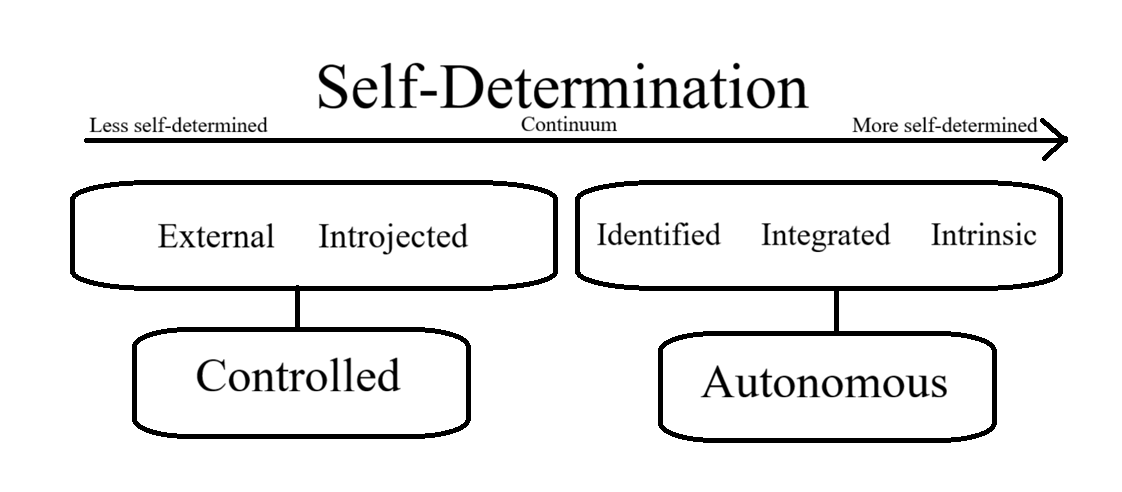
Figure 1. Self-determination continuum
-
External regulation refers to behaviour driven by the desire to obtain rewards or avoid punishment (Guay, 2022; Valenzuela et al., 2017). In dance, this might look like students rehearsing obsessively to avoid being scolded in class, or entering excessive numbers of competitions in pursuit of trophies, praise, or status.
-
Introjected regulation occurs when behaviour is driven by internal pressures such as guilt, shame, or obligation (Guay, 2022; Valenzuela et al., 2017). While the dancer may understand or agree with the reasons behind the behaviour, it is still controlled. For example, a student attending class while sick because they feel guilty about missing training, despite knowing rest would be more appropriate; or a student who hesitates to ask questions in class due to fear of judgment from their teacher or peers, despite knowing that clarification would support their learning and progress.
-
Identified regulation is a more autonomous form of extrinsic motivation. It occurs when individuals recognise and accept the value of a behaviour, even if they don’t particularly enjoy it (Guay, 2022; Valenzuela et al., 2017). A dancer may not enjoy ballet, but understands its importance for technical foundations or future training goals.
-
Integrated regulation occurs when behaviours are fully aligned with an individual’s values and sense of self (Guay, 2022; Valenzuela et al., 2017). This form of motivation requires a well-developed and stable identity and is therefore rarely assessed in children and adolescents, whose identities are still forming.
Fear-based motivation in dance settings
To move away from theory and into lived experience, it’s important to examine fear-based motivation more directly. Motivation driven by fear — including punishment avoidance, guilt, and conditional approval — has repeatedly been shown to be ineffective, short-lived, and disruptive to both development and wellbeing (Guay, 2022; Hofeditz et al., 2015). It is also fundamentally incompatible with autonomy-supportive environments.
Fear-based motivation narrows attention. When fear is activated, cognitive resources are diverted toward threat avoidance rather than learning, problem-solving, or skill development (Fenselow, 2018). In practice, a dancer who is afraid of being punished or criticised is not focused on refining technique — they are focused on not getting into trouble. Over time, this fear response can become automatic: triggered by a teacher’s presence, the studio space, or even the building itself. Eventually, many dancers cope by dissociating, disengaging or leaving altogether.
Another, often more subtle, form of fear-based motivation emerges in psychologically controlled environments — the opposite of autonomy-supportive ones. Psychological control can include withholding information, implicit pressure, conditional approval, guilt-inducing language, silence, ambiguity, unspoken “no’s,” or expectations that students “should just know better.” In these environments, compliance becomes a survival strategy rather than a meaningful choice (Barber, 1996).
Research shows that psychologically controlled environments erode autonomy, undermine confidence, and increase self-criticism (Barber, 1996; Deci & Ryan, 2000). Importantly, these environments are not always created intentionally. However, intention does not reduce impact — the good news is, they can be changed.
Communication as an ethical responsibility
As discussed earlier, unspoken expectations can create psychologically controlled environments. Research shows that ambiguity increases compliance — not because individuals agree, but because uncertainty encourages self-censorship, self-doubt, self-criticism, and fear of unknown consequences (Reeve, 2012). When expectations and boundaries are unclear, dancers often begin to second-guess themselves and suppress their questions, needs, or ambitions.
Over time, this can lead dancers to stop seeking opportunities or asking for clarification — not due to a lack of motivation, but because they have learned that doing so feels unsafe. The uncertainty around “what will happen if I ask” or “what this no really means” becomes enough to keep them silent.
Importantly, research in educational settings shows that clear communication protects motivation. When teachers explain their reasoning, students are more likely to remain engaged and internally motivated — even when the answer is “no” (Reeve, 2012). Transparency fosters trust. Silence fosters fear.
When support becomes control: understanding enmeshment in dance
Paige, NDC STEP Up Program 2025
In some training environments, support can unintentionally blur into control. This dynamic is often described as enmeshment — when a dancer’s sense of worth, safety, or identity becomes tied to meeting the emotional expectations of parents, teachers, or systems (Bacon & Conway, 2023).
Enmeshment is frequently overlooked because it can resemble commitment, loyalty, sacrifice, or high standards — qualities that are highly rewarded in dance culture. Approval may feel conditional, access to opportunities may feel fragile, and compliance may become the safest way to belong. While these patterns are rarely intentional, their impact can be significant.
When dancers learn, explicitly or implicitly, that their value depends on pleasing others, autonomy is eroded. Motivation shifts from internal desire to external maintenance, and wellbeing becomes secondary to performance. Over time, this can contribute to anxiety, burnout, and difficulty developing a stable sense of self.
The Impact of Unspoken “No’s”
Looking back on my own training, and on conversations I’ve had with other dancers over the years, a consistent pattern emerges: when expectations are unclear and “no’s” are not explained, dancers rarely feel empowered to advocate for themselves.
Instead, many learn to comply quietly, filling in the gaps with their own assumptions — often concluding that they are not ready, not capable, or not trusted. This internalisation happens gradually, and often without anyone explicitly intending harm.
In my experience, this uncertainty does not motivate growth. Rather, it creates hesitation, self-doubt, and a reluctance to ask questions or explore opportunities. Over time, dancers may stop speaking up altogether — not because they lack ambition, but because they have learned that uncertainty feels unsafe.
Reframing the teacher’s role: advocacy rather than authority
At the heart of this conversation is a necessary reframing of the teacher’s role — not as an authority figure to be obeyed without question, but as an advocate for the dancer’s growth, autonomy, and wellbeing. Authority in dance has traditionally been framed as control: control over bodies, choices, timelines, and outcomes. Advocacy, however, asks something different. It requires teachers to use their influence not to direct a dancer’s life, but to support their capacity to make informed, self-directed decisions.
An advocate-teacher does not remove structure, standards, or discipline — these remain essential in technical training. Instead of asking, “How do I ensure my student follows my expectations?”, advocacy asks, “How do I equip this dancer with the skills, information, and confidence to navigate their own path?”
This means recognising that discomfort, disagreement, and independence are not signs of disrespect or disengagement, but often indicators of healthy development. When dancers are encouraged to ask questions, express uncertainty, or hold differing perspectives, they are not undermining authority — they are developing autonomy.
Advocacy also requires teachers to tolerate a degree of discomfort themselves. Letting go of control can feel risky in a culture that equates outcomes with personal responsibility and reputation. Yet, ethical teaching is not measured by how closely a dancer’s choices mirror a teacher’s values, but by how supported the dancer feels when making those choices.
Ultimately, reframing the teacher’s role is about shifting from ownership to mentorship. Dancers do not belong to their teachers. Their bodies, careers, and identities are not extensions of someone else’s vision. When teachers position themselves as advocates rather than authorities, the studio becomes not just a place of technical training, but an environment where dancers can develop agency, resilience, and a sense of self that extends far beyond the barre.
What Supportive Teaching Might Look Like
So what does an autonomy-supportive environment, and an autonomy-supportive teacher, actually look like?
First, communication is transparent, clear, and open. Facts are not hidden, and “no’s” are explained. While some teachers may believe they are protecting students by withholding information, research consistently shows that ambiguity does more harm than good. When information is missing, students will fill the gaps themselves — and those gaps are most often filled with self-criticism, self-doubt, or assumptions about their own capability or worth.
Supportive teaching also allows students to explore the opportunities that come their way. We cannot control what our students have in their pantry at home, what they do on the weekend, or even how they ultimately choose to train. What we can do is provide them with accurate information, guidance, and encouragement so they can make informed decisions aligned with their goals.
When information is withheld or the reasoning behind a “no” is left unexplained, it is worth pausing to ask why. Often — and usually unintentionally — this comes from a desire to manage our own discomfort, uncertainty, or emotional response to a decision that challenges us. Without realising it, we may use control to regulate ourselves rather than support the dancer.
A dancer’s choices should reflect their goals, values, and aspirations — not their teacher’s preferences, and certainly not serve as a buffer for a teacher’s emotions or ego.
Finally, autonomy support requires trust. When we show students that we trust their capacity to think, reflect, and decide, we create the conditions for mutual trust. And trust is foundational: it allows students to engage openly, take responsibility for their training, and develop into self-directed, resilient dancers.
Paige, NDCloset Photoshoot 2025
A Note to Dancers
To our students: curiosity and ambition are not acts of disloyalty.
These desires arise for a reason. You may not always understand them immediately — and that’s okay. In fact, not knowing is often an invitation to explore, to listen more closely, and to begin shaping your own path toward the dancer you want to become — whether that path leads into the industry, into teaching, or simply into dancing for joy.
I hope your teachers can offer you clear, trustworthy information so you can make informed decisions about your training. I hope you feel supported to ask questions, to explore opportunities, and to trust yourself as you navigate your journey — rather than feeling bound to one that has already been written for you.
Advocating for yourself can feel frightening. It can feel like you are pushing boundaries or stepping on toes. But courage is not the absence of fear — it is recognising fear and choosing to act anyway. You deserve to feel safe asking questions, safe seeking clarity, and safe backing yourself.
Your journey belongs to you.
Autonomy Is Not a Threat
Our training environments should build confident, autonomous dancers — not just technically strong ones. Studios should be places where dancers feel safe to explore opportunities, ask questions, and pursue goals that are meaningful to them as individuals.
Teachers do not lose authority by communicating transparently or respecting dancers’ autonomy. In fact, many find the opposite: clarity, trust, and honest communication often deepen respect and strengthen relationships. When dancers understand the why, they are more engaged, more motivated, and more capable of advocating for themselves.
Creating an autonomy-supportive studio built on clear communication, trust, and wellbeing is no longer optional — it’s foundational.
What helps you feel supported and welcomed in a dance space?
-
Bacon, I. & Conway, J. (2023). Co-dependency and enmeshment: A fusion of concepts. International Journal of Mental Health and Addiction, 21, 3594-3603.
Barber, B. K. (1996). Parental psychological control: Revisiting a neglected construct. Child Development, 67(6), 296-319.
Deci, E. L. & Ryan, R. M. (2000). The “what” and “why” of goal pursuits: Human needs and the self-determination of behaviour. Psychological Inquiry, 11(4), 227-268.
Fanselow, M. S. (2018). Emotion, motivation, and function. Current Opinion in Behaviour Sciences, 19, 105-109. https://doi.org/10.1016/j.cobeha.2017.12.013
Guay, F. (2022). Applying self-determination theory to education: Regulations types, psychological needs, and autonomy supporting behaviours. Canadian Journal of School Psychology, 37(1), 75-92. https://doi.org/10.1177/08295735211055355
Hofeditz, M., Nienaber, A. M., Dysvik, A., & Schewe, G. (2015). “Want to” versus “have to”: Intrinsic and extrinsic motivators as predictors of compliance behaviour intention. Human Resource Management, 56(1), 25-49. https://doi.org/10.1002/hrm.21774
Howard, J. L., Bureau, J., Guay, F., Chong, J. X. Y., & Ryan, R. M. (2021). Student motivation and associated outcomes: A meta-analysis from the self-determination theory. Perspectives on Psychological Science, 16(6), 1300-1323. https://doi.org/10.1177/1745691620966789
Nakhla, G. (2025). The modulatory role of extrinsic motivation in the relationship between fear of failure and student engagement. Journal of University Teaching & Learning Practice, 22(2), 1-22. https://doi.org/10.53761/hpafhv81
Reeve, J. (2012). A self-determination theory perspective on student engagement. In S. L. Christenson (Eds.), Handbook of research on student engagement (149-172). Springer Science. https://www.doi.org/10.1007/978-1-4614-2018-7_7
Steinberg, L. & Morris, A. S. (2001). Adolescent development. Annual Review of Psychology, 52, 3-110. https://doi.org/10.1146/annurev.psych.52.1.83
Valenzuela, R., Codina, N., & Pestana, J. V. (2017). Self-determination theory applied to flow in conservatoire music practice: The roles of perceived autonomy and competence, and autonomous and controlled motivation. Psychology of Music, 46(1), 33-48. https://doi.org/10.1177/0305735617694502
Zaccone, M. C. & Pedrini, M. (2019). The effects of intrinsic and extrinsic motivation on students' learning effectiveness: Exploring the moderating role of gender. International Journal of Educational Management, 33(6), 1381-1394. https://doi.org/10.1108/IJEM-03-2019-0099