Training for Peak Performance
Dancers and teachers often assume that peak performance refers to a dancer’s best live performance — the moment they win first place, receive a promotion, land a soloist role, or execute every step perfectly. While these moments may reflect peak performance, sport psychology defines the concept in a much broader and more useful way.
Peak performance is not limited to performances in front of an audience or competition outcomes. Dancers can experience peak performance in the studio during classwork, during rehearsals, in strength and conditioning classes, or even in practices such as Pilates or yoga. In other words, peak performance can occur whenever the right psychological and environmental conditions are present (Harmison, 2006; Nickerson, 2025).
One of the most exciting aspects of sport psychology is that peak performance does not have to be left to chance. Rather than simply hoping for a good day or wishing for luck to appear at the right moment, dancers can actively train their psychological skills and create the conditions for peak performance.
However, the dance world has historically been slow to adopt psychological training methods. Directors and teachers have often been reluctant to introduce psychological processes, interventions, or skill development into training environments (Ohuruoga et al., 2016). Instead, dance culture has frequently prioritised competition, conformity to aesthetic ideals, and rigid expectations over a dance’s psychological wellbeing (Dwarika & Haraldsen, 2023).
The result is a culture that can produce dancers who are physically overtrained but psychologically underprepared. Without opportunities to develop psychological skills, dancers may struggle to manage stressors both within dance and in everyday life, including developing flexible coping strategies and healthy interpersonal skills (Dwarika & Haraldsen, 2023).
This blog explores peak performance from a sport psychology perspective. By understanding peak performance as a psychological state that can be developed, rather than a rare moment of luck, dancers and teachers can begin to cultivate the mental and environmental conditions that support both wellbeing and high-level performance.
What Is Peak Performance According to Sport Psychology?
Across the literature, peak performance has been defined in several ways. This variation is common when defining and measuring psychological concepts, particularly when applying them to fields such as sport or dance where research is still relatively new. Despite these differences, most researchers agree that peak performance refers to a state of optimal functioning, in which an athlete performs above their usual level of ability (Cooper et al., 2021; Harmison, 2011; Hatfield et al., 2021; Ohuruoga et al., 2016).
During peak performance, dancers often achieve personal bests or reach meaningful goals while simultaneously feeling competent, focused, and in control. In this state, they are able to regulate their cognition, emotions, and behaviour effectively, allowing movement to feel more automatic and effortless (Cooper et al., 2021; Hatfield et al., 2021).
Importantly, peak performance should not be confused with a dancer’s single best performance. Rather, it refers to a reliable and accessible high-level performance, particularly in demanding or high-pressure situations.
At its core, peak performance involves achieving an ideal mind–body state. While this state may vary slightly from dancer to dancer, it typically includes feelings of confidence, energy, calmness (without excessive anxiety), and control. Dancers in this state tend to experience strong concentration and task-focused attention, a sense of competence and control, positive thoughts toward the task, and a high level of determination and commitment (Harmison, 2011).
Research has identified a number of psychological skills and strategies that are associated with athletes achieving peak performance (Harmison, 2011). These include:
imagery and mental rehearsal
goal setting
pre-performance routines and preparation strategies
refocusing plans during training or competition
positive and adaptive coping strategies
anxiety management techniques and facilitative interpretations of anxiety
attentional control and refocusing skills
By developing and practising these skills, dancers can begin to build what might be described as a psychological tool belt—a collection of strategies they can draw upon to help regulate their mind–body state and enhance performance.
Before moving further into these skills, it is useful to consider a framework presented by Hardy et al. (1996, 2000; as cited in Harmison, 2011). This framework highlights several psychological components that contribute to peak performance and can help coaches better understand how psychological factors influence training outcomes.
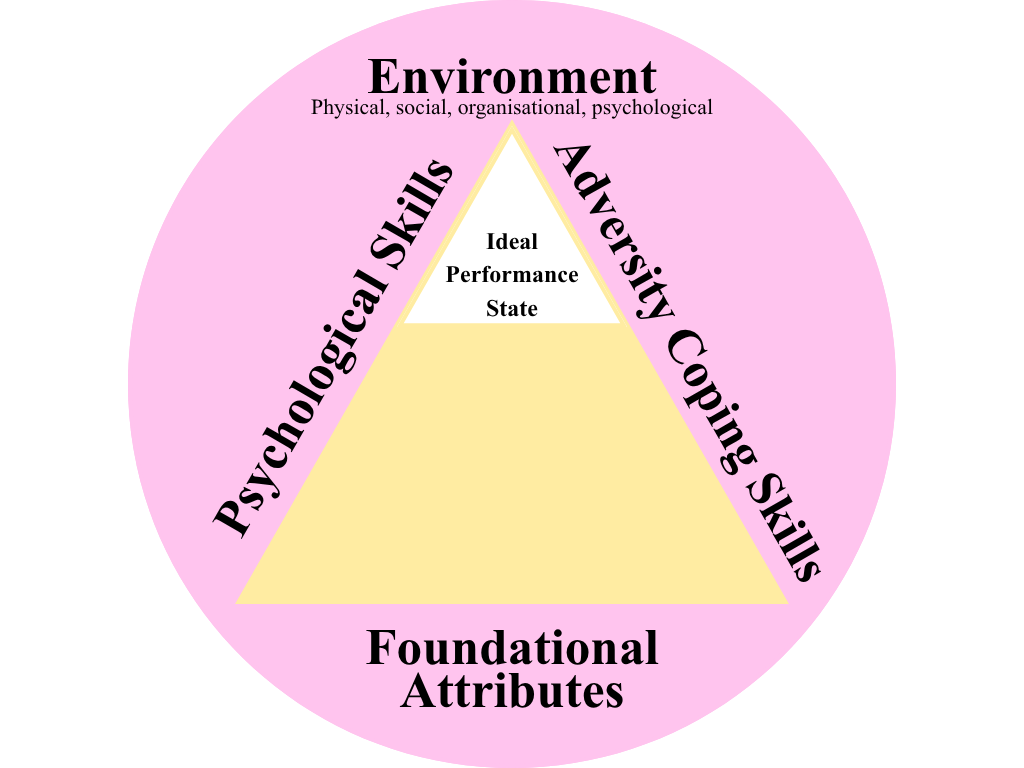
Figure 1: Framework by Hardy et al.
Figure 1 illustrates a visual representation of the framework.
At the centre of the framework is the Ideal Performance State, representing the optimal combination of emotional, cognitive, and physical conditions required for peak performance (Harmison, 2011).
On either side of this state are psychological skills and adversity coping skills. These skills help dancers manage stress, regulate their responses to challenges, and maintain the mental conditions necessary for effective performance (Harmison, 2011).
Underlying these elements are the dancer’s fundamental foundational attributes, including personality traits, motivational orientation, beliefs, and values. These attributes can influence a dancer’s mind–body state both directly and indirectly. Understanding these individual differences allows teachers and coaches to apply strategies in ways that are better suited to each dancer’s specific needs.
Above everything is the environment as this plays a huge role in how all the other parts of the framework operate (Harmison, 2011).
Why Does Dance Complicate Peak Performance?
Why does dance culture often make it more difficult for dancers to achieve peak performance, particularly within the studio environment?
A scoping review of dance literature by Dwarika and Haraldsen (2023) found that 49 studies described the dance environment and culture as unrelenting. As dance exists at the intersection of sport and art, it often operates within highly evaluative and aesthetically focused environments. These conditions can make it increasingly difficult for dancers to achieve the ideal mind–body state required for peak performance.
In addition, dancers must often navigate a number of unique stressors—many of which have become normalised within dance culture. These may include constant observation and comparison, expectations to maintain both high physical fitness and a particular aesthetic ideal, and pressure to perform at a consistently high physical level. Dancers may also encounter authoritarian teaching styles, competition with peers, and the challenge of balancing personal goals with the desire to avoid disappointing authority figures, who hold significant influence over their social standing, performance opportunities, and career pathways (Dwarika & Haraldsen, 2023).
Of course, not every dancer will experience all of these challenges. However, even a small number of these stressors can place significant pressure on the nervous system. For some dancers, this can lead to a persistent state of heightened anxiety.
When dancers remain in a prolonged state of stress or hypervigilance, it becomes extremely difficult to access the psychological conditions required for flow and peak performance. In other words, when the nervous system is operating in survival mode, the ideal mind–body state necessary for peak performance is far less likely to occur.
The Nervous System’s Role in Performance
Many of our nervous system responses evolved long before modern society—when humans were still living in caves and facing immediate physical threats such as predators. One of the most well-known responses is the fight–flight–freeze response (Hatfield et al., 2021; Maak et al., 2015). This response is triggered when we perceive danger.
Historically, this response served a clear survival function. If a person encountered a predator, they would either fight the threat or run away. However, the types of “danger” modern humans encounter are very different from those our nervous systems originally evolved to handle (Hatfield et al., 2021; Maak et al., 2015). Today, the same response might be triggered by situations such as auditions, performances, or even something as simple as an unexpected phone call.
Because of its evolutionary origins, this reaction is often referred to as a survival response. When the brain enters survival mode, resources are redirected toward immediate protection rather than higher-level functioning. As a result, other processes—such as creativity, complex decision-making, and fine motor control—can become less accessible (Hatfield et al., 2021).
Under high stress, the body experiences several physiological changes. Muscles may become tense, attention may narrow, and our ability to think critically, creatively, or flexibly can decrease (Hatfield et al., 2021; Nickerson, 2025). These changes can make achieving peak performance far more difficult.
This means that when dancers feel they did not perform at their best, the issue may not always be a lack of physical preparation. Instead, the nervous system may simply feel unsafe, overwhelmed, or dysregulated. In these situations, a dancer’s attention can shift away from the task itself—such as timing, artistry, or previously learned corrections—and toward perceived threats like the fear of making mistakes or receiving a poor score.
The nervous system therefore plays a particularly significant role in dance performance, where both physical precision and cognitive focus are required simultaneously.
One way psychologists have conceptualised the relationship between stimulation and performance is through the Yerkes–Dodson Law. This principle suggests that performance improves as mental or physiological stimulation increases—but only up to a certain point (Nickerson, 2025). Once stimulation exceeds this optimal level, performance begins to decline.
This relationship is often illustrated as an inverted-U curve (see Figure 2). At very low levels of stimulation, individuals may feel bored or disengaged, which can lead to poor performance. Moderate levels of stimulation can increase focus and energy, improving performance outcomes. However, excessive stimulation can lead to stress, anxiety, and mistakes (Nickerson, 2025). The peak of this curve represents the optimal zone, where peak performance is most likely to occur.
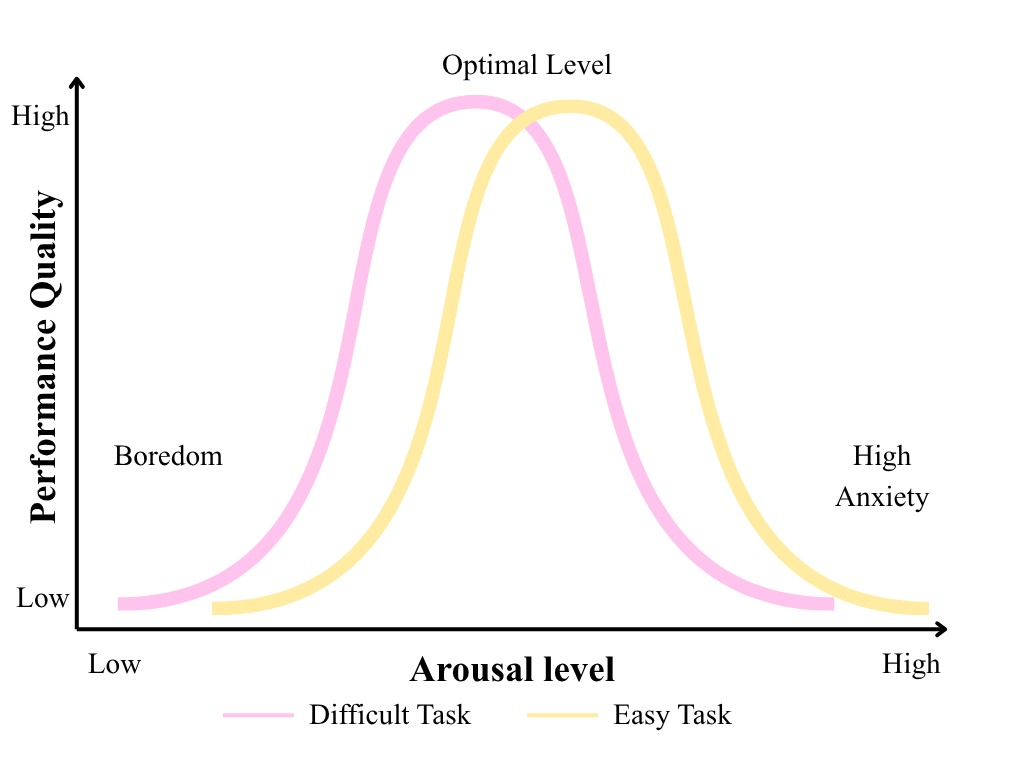
Figure 2: Yerkes–Dodson Law
The relationship between stimulation and performance illustrated as an inverted-U curve. Demonstrates the optimal level may differ according to task difficulty.
Importantly, this optimal zone varies between individuals and situations. Factors such as personality traits, motivation style, task difficulty, and skill level can all influence where this optimal point lies (Nickerson, 2025).
For example, tasks requiring fine motor control and high levels of technical precision, such as ballet variations or complex gymnastic routines, may require lower levels of stimulation. In these situations, slower breathing, focused attention, and consistent warm-up routines can help dancers access their optimal performance zone.
In contrast, more explosive or well-practiced movements, such as fast-paced jazz choreography or powerlifting, may benefit from slightly higher levels of stimulation. Strategies such as energetic cue words, upbeat music, or dynamic warm-ups may help performers reach their optimal level of activation.
Returning to the fight–flight–freeze response, this reaction creates a sudden surge in stimulation. When this increase is moderate, it can actually enhance focus and performance by helping individuals move up the left side of the inverted-U curve. This beneficial form of stress is often referred to as eustress (Nickerson, 2025).
However, if the stress response continues to escalate, it can move beyond this optimal zone and become distress. At this point, working memory and adaptability begin to decline, attention narrows into tunnel vision, and mistakes become more likely.
The inverted-U model is a simplification. Different situations may produce different patterns of stimulation and performance. Nevertheless, the model provides a useful framework for understanding how stimulation levels influence performance.
Based on both my own training experience and my observations as a teacher, this relationship between stimulation and performance appears highly relevant to dance—particularly in ballet, where precision, control, and mental focus are essential.
A Tale of Two Training Environments
When I was ten years old, I had my first experience working with a professional choreographer. Whenever they entered the studio, the entire environment shifted. The atmosphere became noticeably more intense—quieter, tenser, and filled with anxiety. Everyone seemed to move more cautiously, as though one wrong step might trigger a serious negative reaction.
During these classes, my performance would fall sharply to the right side of the inverted-U curve. I struggled to think clearly or creatively, and it became difficult to focus on the steps being taught. Instead, my attention was consumed by the fear of being yelled at or criticised.
Physically, I could feel the impact of this stress response. My muscles became tighter and more rigid, and my technique seemed to disappear almost instantly. My breathing grew shallow, my fingers and toes tingled and sometimes went numb, and at times all I could hear was the pounding of my own heartbeat.
Once my performance began to decline, the situation often escalated further. The choreographer would become more frustrated or agitated, which increased the tension in the room. This created a feedback loop: more fear led to poorer performance, which in turn led to more criticism and even greater anxiety.
In contrast, my experience at the Princess Grace Academy of Dance in Monaco was completely different. Our teacher there was still intense—but in a way that reflected passion rather than intimidation. Mistakes were not met with yelling or humiliation; instead, they became opportunities for learning.
In that environment, I felt closer to the top of the inverted-U curve. I felt competent, strong, and appropriately challenged. For perhaps the first time in my training, I experienced a sense of control over my technique and genuine comfort within the studio. I had never felt so physically capable or mentally focused.
Interestingly, while the boarding experience itself had its challenges, it did not interfere with my ability to find flow in the studio. I approached the experience with the mindset of simply learning and absorbing as much as I could. Because I did not see the experience as an audition or a test of my worth, much of the pressure disappeared.
I was seventeen at the time, and it remains the only time in my dance training that I experienced a true flow state.
Perhaps that is why I am so fascinated by the psychology of performance. Flow is rare for many dancers, and peak performance can also feel elusive. Yet the research shows that these states are not purely accidental—they can be cultivated. By learning to regulate our nervous systems and develop psychological skills, dancers can begin to create the conditions that allow peak performance, and occasionally flow, to emerge. It is also important to note the environment created by the teacher in the studio as well, as this hugely impacts the dancers ability to set the right conditions.
What Peak Performance Looks Like in Dance
Peak performance can look slightly different for every dancer and in different situations. However, there are several observable markers that can indicate when a dancer has reached this optimal state.
Dancers experiencing peak performance tend to display calm focus and strong engagement with the task. They are responsive and adaptable, able to think both creatively and critically while performing. Movement often feels more fluid and effortless, allowing artistry and expression to emerge more naturally.
Another important feature is the balance between challenge and skill. When the difficulty of a task matches a dancer’s level of competence, and their level of stimulation is optimal, performance tends to improve. In these conditions, dancers are more likely to access the ideal mind–body state required for peak performance.
Once dancers learn how to access this state, their technique and artistry can become more consistent under pressure, because they are better able to regulate their reactions, emotions, and mental focus.
Peak performance does not necessarily mean the complete absence of tension or stress. Rather, it often involves the ability to manage and channel that tension effectively (Cooper et al., 2021).
For example, when I used to compete in eisteddfods, I discovered that I actually needed a certain level of stimulation or anxiety in order to perform well. If my anxiety was too low, my performance would feel flat and uninspired. But if my anxiety became too high, my technique would unravel. Learning how to regulate that level of stimulation was crucial.
One experience that clearly demonstrated this, happened when my grandfather came to watch me perform my classical solo at a competition. I had built up so much anxiety about him being there that my technique felt completely out of control. I struggled to think about what steps came next, and instead all my attention was focused on the fear that he was watching me perform poorly.
On the other hand, shortly after returning from my time in Monaco, I competed at an eisteddfod the very next day while extremely jet-lagged. At that point, I honestly did not care how I performed. The solo felt uninteresting compared to the incredible experience I had just had, and I was physically exhausted. Unsurprisingly, that performance was also poor—this time because my stimulation levels were likely far too low.
The times when I performed at my best were when my stimulation levels sat somewhere in the middle. When I won a championship, I remember feeling the right balance of excitement and nervousness. I cared about performing well, and I wanted to do my best, but my anxiety was manageable.
I also had routines that helped regulate my state before performing. On the way to competitions, I would listen to my music repeatedly in the car. I followed the same warm-up routine each time, which helped wake up my muscles and increase my energy levels. In the wings before stepping on stage, I would use a breathing routine to settle my nerves.
When those pieces were in place, I was able to reach a level of stimulation that supported peak performance.
Training for Peak Performance
Peak performance is not reserved only for competitions, auditions, or live performances. In fact, one of the best ways to access peak performance during those moments is to practice creating the conditions for it during everyday training.
When dancers rehearse their preparation routines regularly in class, the process becomes familiar. Then when high-pressure situations arise, dancers are not only prepared technically—they are also psychologically prepared.
Here are several strategies dancers can use to help create the conditions for peak performance during training.
Develop a Consistent Warm-Up Routine
A structured warm-up routine can help regulate both the body and the nervous system before class.
Take a few moments to warm up in a quieter space if possible. This might include listening to your own music, gently warming each muscle group, performing light dynamic stretches, and activating the core. Consistency in this routine can help signal to the body and mind that it is time to focus.
Use Cue Words and Supportive Self-Talk
Cue words can help direct attention and regulate stimulation levels.
For slower styles such as ballet or contemporary, calmer cue words or internal dialogue can support focus and control. In more energetic styles such as jazz, more activating language may be helpful.
Regardless of the style, self-talk should remain constructive and supportive. The goal is to guide performance, not criticise it.
Reframe Mistakes
Mistakes are not failures—they are information. Each correction or error provides insight into what needs adjusting.
When dancers begin to view mistakes as tools for learning rather than proof of inadequacy, they create a mental environment that supports experimentation and growth.
Separate Your Worth From Your Outcomes
One of the most important psychological skills dancers can develop is the ability to separate their self-worth from their training outcomes.
You are far more than how one class went. You are more than a difficult turn day, a missed step, a disappointing performance, or a piece of negative feedback. Your value as a person does not fluctuate with every correction or evaluation.
Create a sound training program
“The foundation of every peak performer’s training is contained in a single word: program…” (Garfield & Bennett, 1984; as cited in Harmison 2011, p. 3). Without a well developed and focused program, dancers can waste a lot of time wandering down a path to excellence which turns out to be a cul-de-sac that goes nowhere.
That being said, it is also important to develop a plan that can be adaptable for when things do go wrong.
A plan should include SMART goals, warm-up and cool-down routines, anxiety and stress management strategies, If-What statements (if I am tired, I will run on the treadmill for 5 minutes instead of 10 today). The program should include a list of things that keep the dancer motivated and a list of what helps them to reach the optimal zone of stimulation. For example, checking in on my SMART goals helps me stay motivated and ensuring I do my warm-up before class helps me reach my optimal zone of performance for class.
Understanding Your Stimulation Level
Recognising whether you are over-stimulated, under-stimulated, or optimally stimulated can help you adjust your approach during training (Nickerson, 2025).
Over-Stimulation
Signs may include:
racing thoughts
rushing through movements
muscle tension
frequent mistakes
mind blanks
feeling twitchy or fidget
Strategies to regulate:
slow your breathing (for example, inhale for 4 counts and exhale for 6)
move to a quieter or less stimulating environment if possible
break the task into smaller, manageable pieces
begin with the simplest step
consciously relax the shoulders, jaw, and tongue
Under-Stimulation
Signs may include:
boredom or low motivation
procrastination or slow starts
drifting attention
feeling as though nothing is “sticking”
Strategies to increase activation:
stand up or walk around briefly
begin with a simple starter task
add structure such as a timer or short goal
play background music or noise to increase stimulation
Optimal Stimulation
Signs you may be in your optimal zone include:
having a clear goal
feeling present and focused
working at a steady pace
catching small errors quickly
experiencing time passing normally
Ways to maintain this state:
take short breaks before fatigue sets in
stay focused on the current goal rather than adding new ones
maintain a stable environment (temperature, noise level, and comfort)
The Teacher’s Role in Peak Performance
Teachers also play an important role in shaping the conditions that support peak performance.
This includes creating psychologically and emotionally safe learning environments where experimentation, mistakes, and growth are encouraged. Clear expectations, well-timed feedback, and process-focused corrections can all help dancers remain engaged and confident in their learning.
While teachers cannot directly create peak performance for their students, they can create the conditions that allow dancers to thrive.
Final thoughts
Peak performance is not something we can force. It is not a switch that can simply be turned on at will.
However, by understanding the role of the nervous system, managing stimulation levels, and developing psychological skills alongside physical technique, dancers can begin to create the conditions that make peak performance more accessible and more consistent.
Rather than leaving great performances to luck, dancers and teachers can learn to support the mind and body in working together—allowing moments of peak performance, and occasionally even flow, to emerge.
Peak performance may look like magic on stage, but behind the scenes it is often the result of a well-trained mind and a well-supported body.
-
Cooper, J., Johnson, M., Radcliffe, J., & Fisher, J. (2021). Optimal emotional profiles for peak performance in strength and conditioning. The Journal of Strength and Conditioning Research, 35(3), 33-840. https://doi.org/10.1519/JSC.0000000000002832
Dwarika, M. S. & Haraldsen, H. M. (2023). Mental health in dance: A scoping review. Frontiers in Psychology, 21(14). https://doi.orh/10.3389/fpsyg.2023.1090645
Harmison, R. J. (2011). Peak performance in sport: Identifying ideal performance states and developing athletes’ psychological skills. Professional Psychology: Research and Practice, 37(3), 233-243. https://doi.org/10.1037/072.37.3.233
Hatfield, J. L., Roberts, G. C., & Lemyre, P. N. (2021). Peak performance. In G. McPherson (Eds.), The oxford handbook of music performance (2nd ed., pp. 42-64). Oxford University Press.
Maak, D., Buchanan, E., & Young, J. (2015). Development and psychometric investigation of an inventory to assess fight, flight, and freeze tendencies: The fight, flight, freeze questionnaire. Cognitive Behaviour Therapy, 44(2), 117-127. https://doi.org/10.1080/16506073.2014.972443
Nickerson, C. (2025, August 14). Yerkes-Dodson law of arousal and performance. Simply Psychology. https://www.simplypsychology.org/what-is-the-yerkes-dodson-law.html
Ohuruogu, B., Jonathan, U. I., & Ikechukwu, U. J. (2016). Psychological preparation for peak performance in sports competition, Journal of Education and Practice, 7(12), 47-50.